For smartphones selling at over $600, Apple owns 65% of that market and grew 9% year over year in the first half of 2026. However, Chinese brands are making a dent in local market share.
Apple ships 23% of all smartphones sold globally and captures 49% of all profit. It's a behemoth on its own, but when accounting for smartphones in the $600 plus range, it's the clear leader in market share.
According to a report from Counterpoint Research, Apple captured 65% of the global premium smartphone market. It grew 9% year over year during the first half of 2026, though its market share is still down when compared to the 74% held in 2022.
The decline since 2022 can be attributed to the premium Chinese smartphone market growing in popularity. When a Chinese consumer is presented with an option between an iPhone and a smartphone from Huawei, Xiaomi, or Oppo, they choose the local brand.
That said, Apple still holds most of the market globally at 65% and Samsung at 19%. The other OEMs make up the remaining 16%.
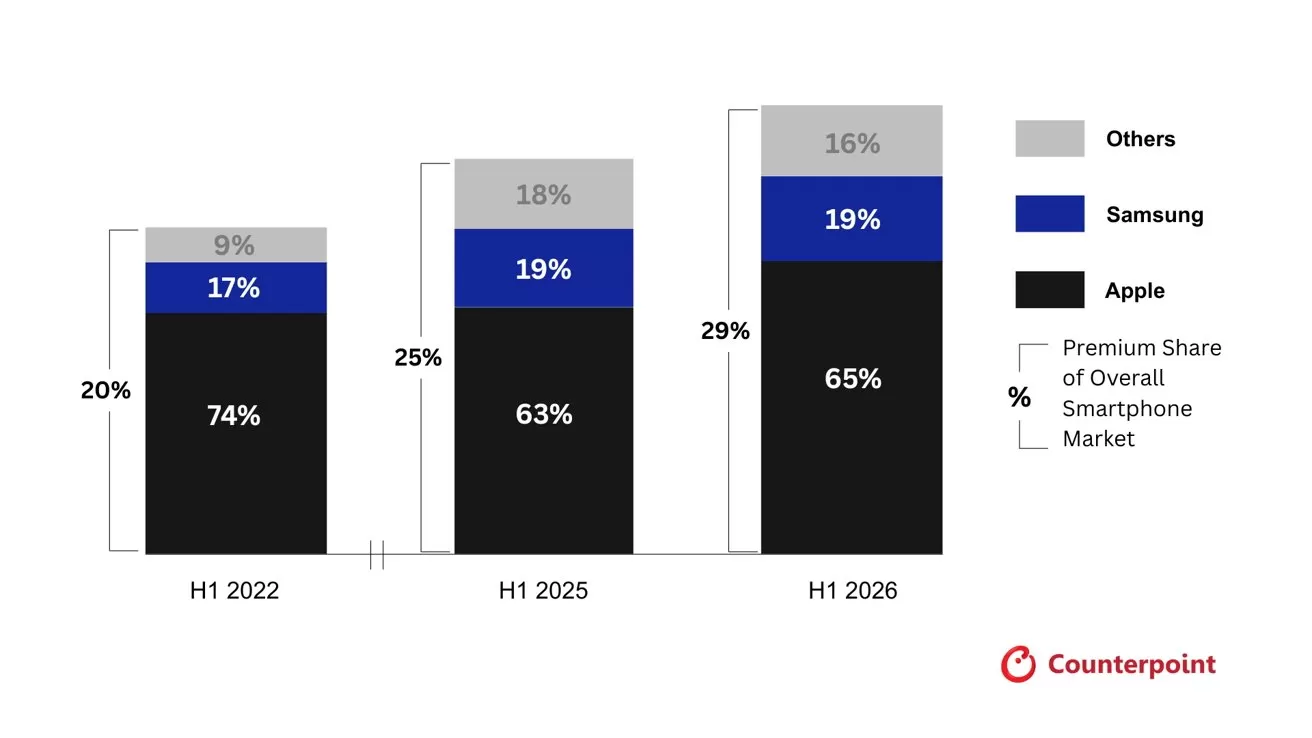
Apple holds onto 65% of premium market share even as the rest of the market increases prices. Image source: Counterpoint
The premium smartphone market grew 5% overall year over year for the first half of 2026 and makes up a record 29% of the global market. The global RAM shortage driving up prices has pushed more smartphones into the premium $600 plus segment and price hikes on lower-end models are driving customers to more premium models.
The report suggests these trends are why smartphone manufacturers are leaning further into financing options. Samsung recently launched its Galaxy Card while Apple has introduced Apple Upgrade.
Trade-in prices have also gone up, as was seen with Apple earlier Thursday. Everything is meant to entice customers holding onto their more expensive devices for longer to upgrade sooner in spite of price increases.
It's going to be an interesting fall as everything seems to be creating quite the hurdle for Apple to overcome. iPhone 18 Pro sales could be limited by the RAM shortage and Apple reports that it's already selling as many iPhone 17 models as it can make.
Demand won't be the issue, but supply held back by global supply chain instability. Consumers may be feeling the impact of economic uncertainty, but that may not matter if financing options continue to be plentiful.