New research that suggests that future iPhones, iPads, or perhaps Apple Watches could have a stretchable display on the outside, instead of one that just folds inward. Here's how Apple plans to do it.
For years now, Apple has been expected to produce a folding screen iPhone, and that's more than likely to appear at the September 9, 2026 event. But all along, at lease 50 Apple engineers have been working instead on stretchable displays.
That's how many are credited on the newly-granted patent that's just called "Stretchable Display." It's at least five times more than are normally credited on an Apple patent, and so this is a serious and longterm commitment by Apple.
The inventors are chiefly based in either California or Taiwan, where Apple has a research center. They're also remarkably concise, with the patent application having 12 images and just 21 pages.
That's actually slightly more concise than when Apple first applied for this patent in 2024. Back then there were 22 pages and 13 images.
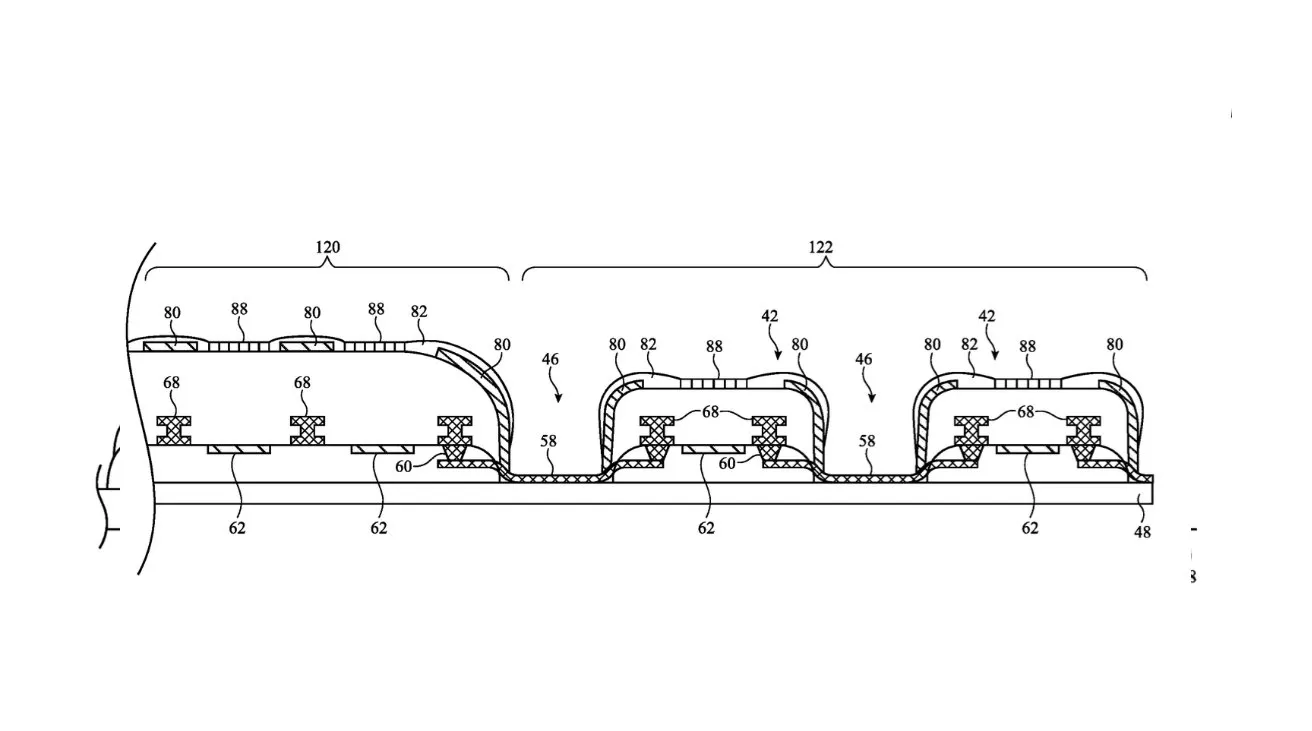
Detail from the patent application showing that the flat sections between the risen components could be flexible
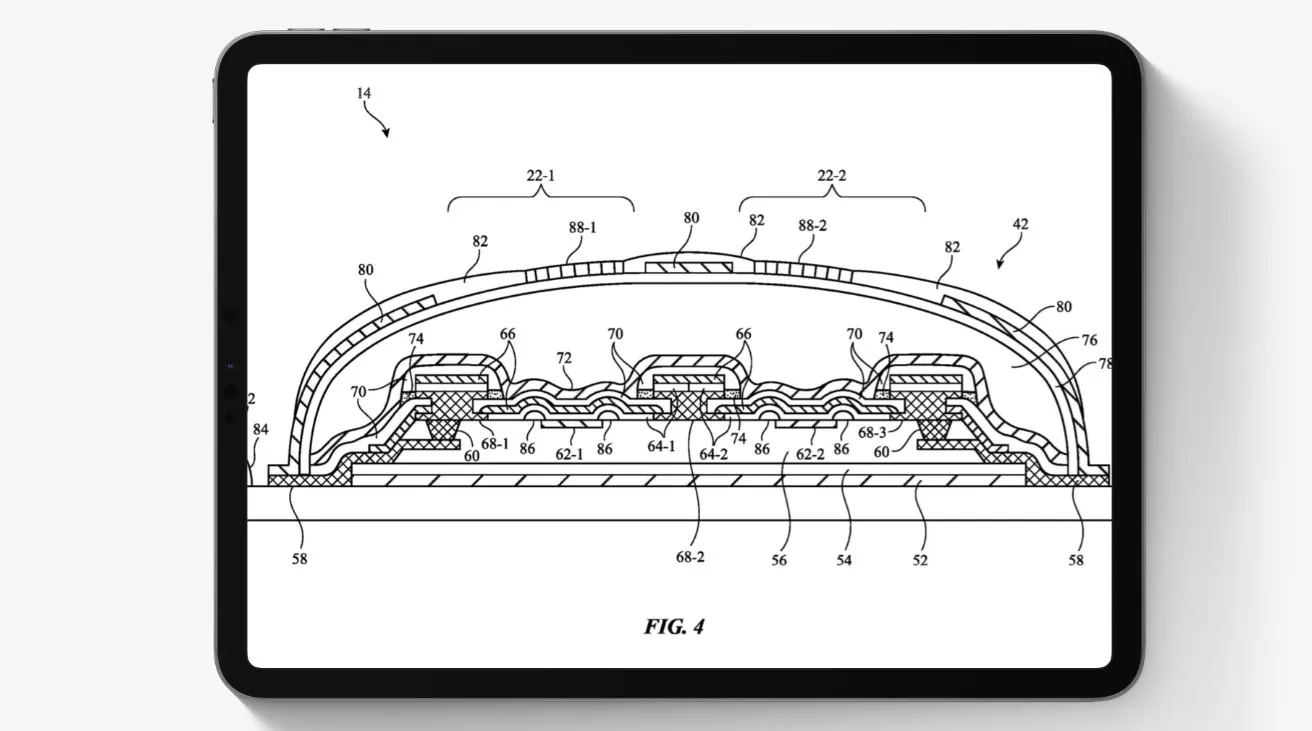
What those and the remaining pages concentrate on, though, are the specifics of having a stretchable display. It could "include a plurality of hermetically sealed rigid pixel islands and a flexible interconnect region," says the patent.
Imagine any flexible material being studded at close and regular intervals with individual groups of pixels. None of the actual display elements would bend or stretch, but the entire surface they are on would.
"Each hermetically sealed rigid pixel island may include at least one organic light-emitting diode pixel with organic light-emitting diode layers interposed between first and second electrodes," continues the patent, "and a conductive cutting structure that causes a discontinuity in one of the organic light-emitting diode layers and that is electrically connected to the second electrode."
So there would still need to be circuitry linking each of these display elements or pixel islands. That must limit just how stretchable or bendable the overall material is, but the patent doesn't detail that.
It does detail much about its proposed technology, but, as is typical for any patent, it's very light on examples of how stretchable displays could be used.
What it could be used for
There are some suggestions, starting with how Apple wants the patent to cover every type of device it can. So the patent is for "a laptop computer... a cellular phone..." or any of more than a dozen different devices.
Among those, though, there is reference to "a smaller device such as a wrist-watch device, a pendant device, a headphone or earpiece device, a device embedded in eyeglasses or other equipment worn on a user's head, or other wearable or miniature device." But there are also larger displays, such as "mounted in a kiosk or automobile."
As ever, the purpose of the patent is more to cover how something may be done, rather than what could then happen with the technology.
So this may be extrapolation, but there are use cases where a stretchable display would be of more benefit than a folding one. For instance, a future iPhone Ultra could have a foldable screen on the inside, but a stretchable one that wraps around the whole of the outside.
But then there have of course long been rumors of a HomePod with a screen, sometimes called a HomePad. The assumption is usually that this HomePod would be a squared-off design instead of its current cylinder, but Apple has already looked at a display that would effectively wrap around the device.
Similarly, this stretchable display technology might address another long-reported aim of Apple. Back in 2023, it was revealed that Apple wants to make an Apple Watch screen that wraps all the way around the wrist.
It's important to note that at present this is only an application for a patent. Apple applies for thousands of patents every year, and not all are granted.
Plus, even when Apple is granted a patent, it is not a guarantee that we will ever see its proposals realized in a shipping product.