Apple captured 49% of global smartphone revenue in the second quarter despite accounting for only 23% of shipments, showing how much more money the iPhone generates per device than competing smartphones.
The company's iPhone revenue climbed 22% year over year in the second quarter, the fastest increase among the five largest brands, according to preliminary data from Counterpoint Research. Its share of global smartphone revenue reached a second-quarter record of 49%, up from 44% a year earlier.
Apple's growth came from higher shipments and a more expensive sales mix. Counterpoint's latest report estimated that shipments rose 13% from a year earlier, while Apple's average selling price increased 8% to $946.
Counterpoint attributed the performance to sustained demand for the iPhone 17 lineup, particularly the base iPhone 17 and iPhone 17 Pro Max. Demand for the two models helped keep Apple's product mix concentrated on premium devices without requiring the steep price increases imposed by some competitors.
The research firm said Apple's largely stable pricing improved the iPhone's value as memory costs rose across the industry. Many Android manufacturers depend more heavily on entry-level and midrange devices, where price increases can quickly weaken demand.
Apple gained a similar advantage in China, where rising Android prices made discounted iPhones more competitive. The regional results support Counterpoint's argument that pricing helped Apple gain ground, although they do not prove that every market followed the same pattern.
Apple's premium product mix and ability to absorb higher component costs gave it an advantage over several rivals. The company increased both estimated revenue and shipments even as the broader smartphone market shipped fewer devices.
Apple gains as smartphone shipments fall
Global smartphone shipments declined during the quarter, but total revenue increased 7% year over year to a second-quarter record of $109 billion. The industry's average selling price rose 17% to $400 as price increases and a greater share of premium devices lifted the amount earned from each sale.
Counterpoint's latest chart gave Apple a record 23% share of second-quarter shipments. Apple's revenue share remained much higher because the average iPhone sold for substantially more than devices from competing manufacturers.
The shipment estimate differs from a Counterpoint report published July 13, which put Apple's growth at 3% and its market share at 20%. Counterpoint has not explained whether the newer preliminary figures reflect revised data or a difference in methodology, so the 13% growth estimate should not be treated as settled.
Apple's market performance came alongside a strong fiscal third quarter that ended June 27. The company's record earnings included $54.25 billion in iPhone revenue, up 21.7% from a year earlier.
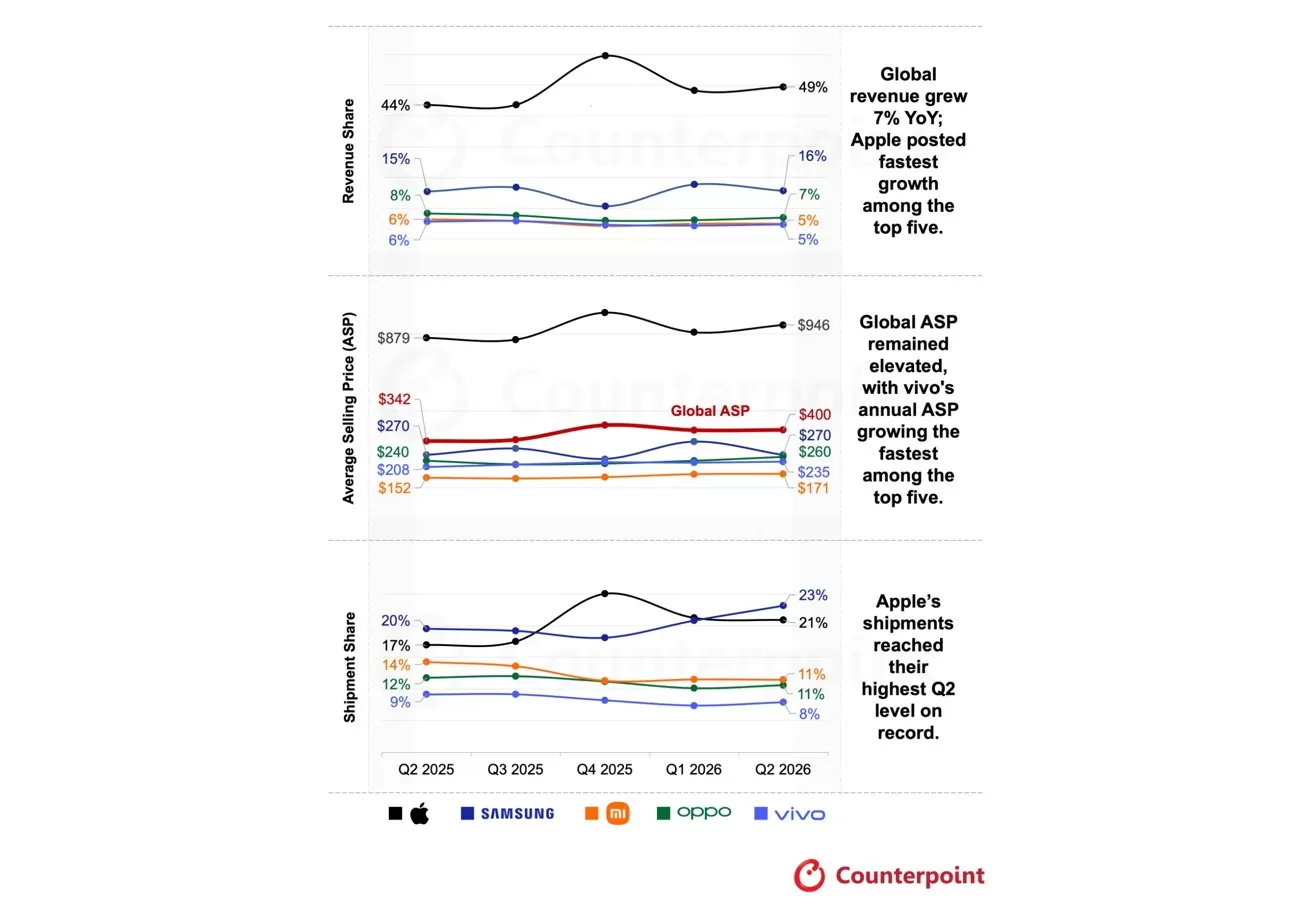 Samsung ranked second with 16% of global smartphone revenue. Image credit: Counterpoint
Samsung ranked second with 16% of global smartphone revenue. Its estimated revenue and shipments each increased 9%, while its average selling price remained roughly flat at $270.
Demand for Samsung's Galaxy A-series supported shipment growth, while the Galaxy S26 lineup strengthened its premium business. Counterpoint also credited Samsung's vertical integration and control over component sourcing with helping it limit price increases.
Xiaomi recorded the steepest shipment decline among the five largest brands, falling 26% year over year. Its revenue dropped 17% even as its average selling price rose 13%.
OPPO and vivo posted revenue declines of 10% and 11%, respectively, despite higher average selling prices. Falling shipments outweighed the additional revenue each company collected per device.
The results show the limits of relying on higher prices in cost-sensitive parts of the market. Xiaomi, OPPO and vivo shifted toward more expensive devices, but the higher average selling prices did not offset their shipment declines.
Higher iPhone prices may still be coming
Apple remained relatively insulated from rising component costs during the second quarter, according to Counterpoint. The research firm expects Apple to raise iPhone prices in coming quarters as memory shortages continue.
Separate Counterpoint estimates suggest rising DRAM and NAND costs could add hundreds of dollars to the production cost of the iPhone 18 Pro Max. The projected increases have not translated into confirmed retail pricing, but higher component costs could make Apple's current advantage harder to maintain.
Counterpoint also expects global smartphone shipments to decline more sharply during the second half of 2026. The firm said limited supplies are becoming a greater constraint as manufacturers face persistent memory shortages and higher costs.
The second-quarter results show that Apple benefited by holding prices steadier than several Android rivals while continuing to sell more premium models. Apple may struggle to preserve that combination if component costs eventually force broader iPhone price increases.