
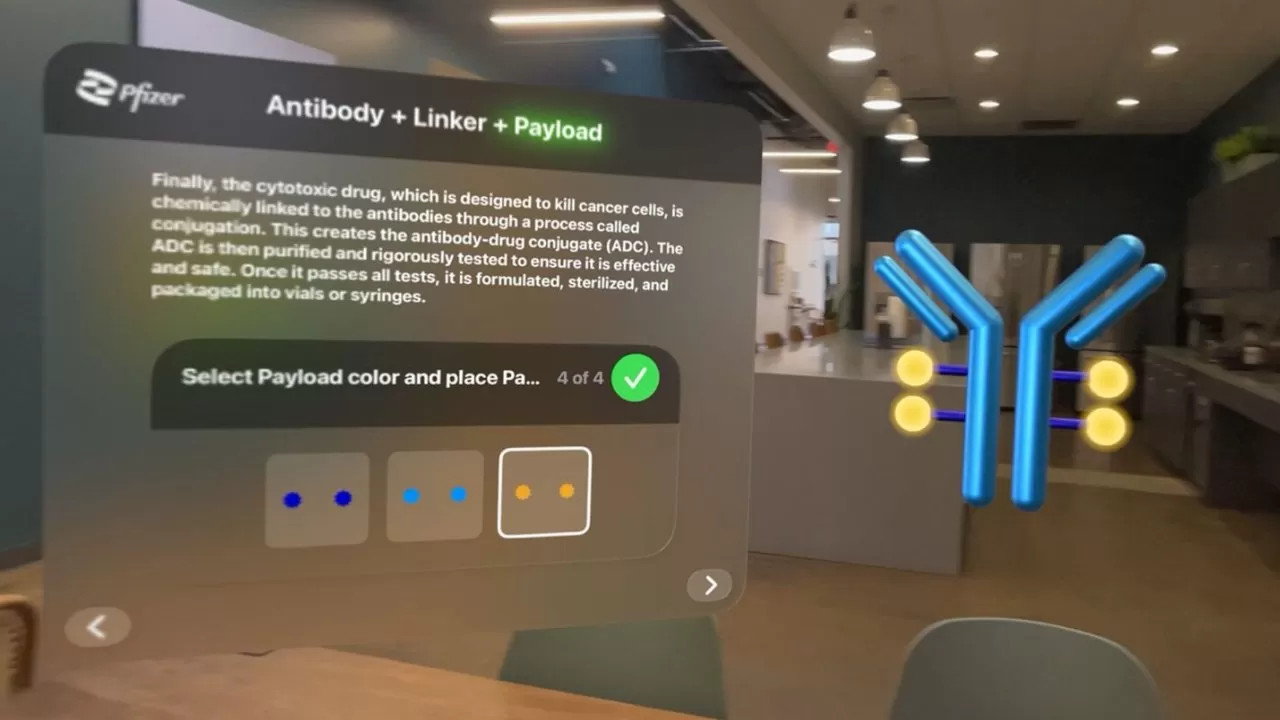
Pharmaceutical firm Pfizer has turned to Apple Vision Pro to make an experience that's meant to help cancer patients understand how the company conducts its research into the disease, but looks more like an infomercial.
Among its many other medical uses, Apple Vision Pro has been used to help with cancer detection. But now pharmaceutical technology corporation Pfizer is using it as an education and support device.
According to Groove Jones, which developed the Apple Vision Pro immersive experience, the headset is being used to communicate Pfizer's "story of resilience and groundbreaking cancer treatments."
What the Apple Vision Pro wearer sees first is a series of films of real-life cancer stories from patients, their families, and Pfizer scientists talking about the disease. Only, if the stories are real, apparently the people are not.
"This proprietary technology creates ultra-high-resolution stereoscopic images representing real patient stories, preserving identities while authentically capturing emotion," it says. "Custom depth maps enhance emotional engagement through lifelike 3D imagery."
That's a lot of trouble to go to when they could've just pointed an iPhone 15 Pro or later to record Spatial Video of real people telling their stories. And when the real people could've conveyed emotion quite well enough, thank you.
Groove Jones is also a little patronizing about what it means having anyone speak about their experiences. The company explains that this "storytelling approach ensures the experience deeply resonates and moves audiences."
The audience is primarily cancer sufferers and family members, so they already know and are already moved by the subject. Nonetheless, they and any other user can then move on into a 3D laboratory.
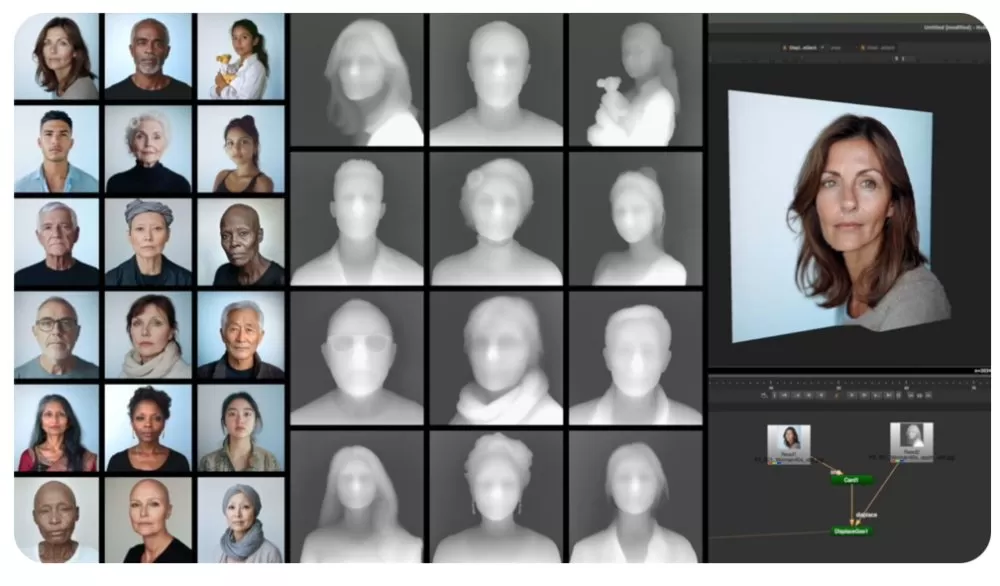
The experienced used specially-developed 3D modelling techniques instead of just filming people - image credit: Groove Jones/Pfizer.
That AI system with the custom depth maps was also used to film actual Pfizer scientists who are now placed within this 3D lab. In the videos shown by the company, however, these scientists are photorealistically stationary.
Presumably there is some interaction, because then the headset wearer is prompted through the contents of the lab, described as "accessing information, exploring advanced technologies, and engaging directly with scientific innovations."
Build your own cancer drug
That last is the key part of the experience, with the wearer getting to manipulate what Pfizer calls the ADC Builder. This is where the user can "design their own Antibody-Drug Conjugate," which is Pfizer's chief cancer therapy.
This is presented as a kind of reverse-Jenga, where the headset wearer drags blocks to build up a model. It's a four-step process where each part is accompanied by an explanatory description of around 60 words.
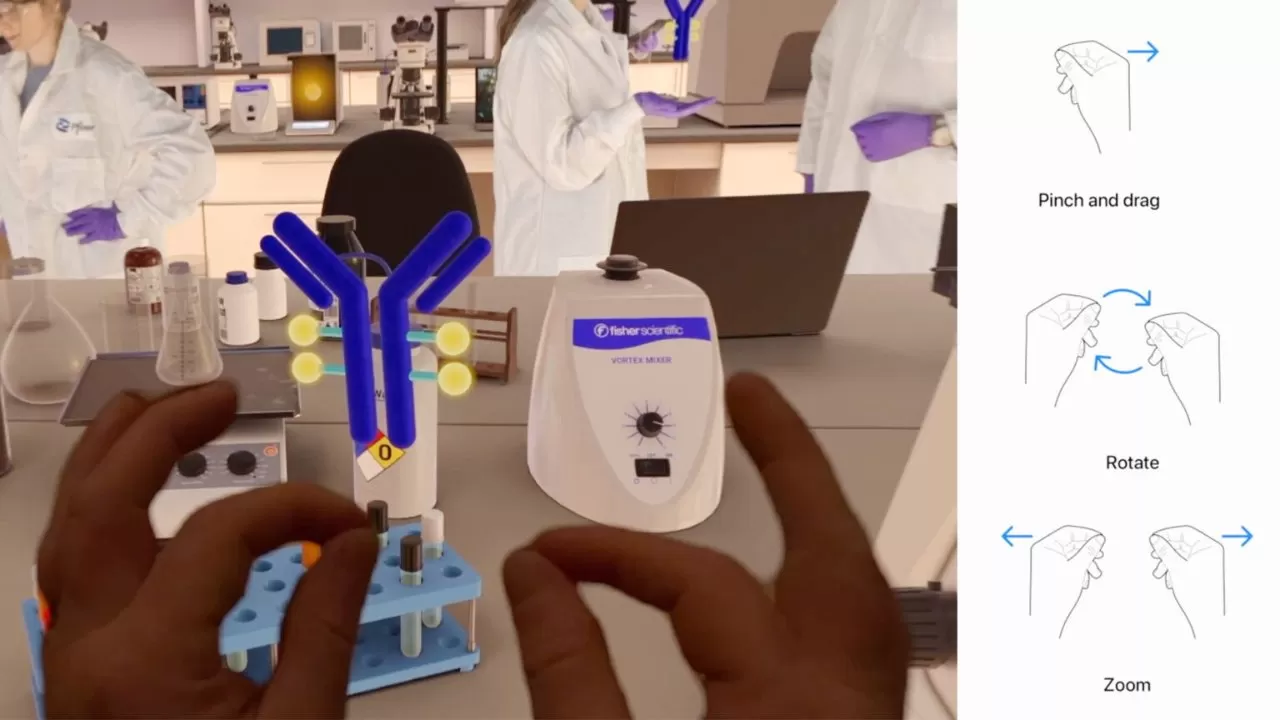
Users can assemble their own cancer treatment drugs, to an extent - image credit: Groove Jones/Pfizer.
Then they get to see an animation of their newly-created drug entering the bloodstream. Since Groove Jones points out that it actually takes "10 to 15 years of rigorous research, testing, and clinical trials" to make a new such drug, knocking one out in 30 seconds doesn't seem very illustrative of the process.
Nonetheless, the company insists that using "spatial audio and real-time 3D visualization make complex scientific concepts engaging and clear."
It's surely different and more immersive when you take part through an Apple Vision Pro instead of watching the company's videos and screenshots. But it feels as if those 60-word captions are all that's actually needed.
Apple Vision Pro does need more immersive experiences, and this is an immersive experience. But it's one that feels as if it's only ever going to be watched to the end at Pfizer events.