The iPhone Duo developing a crease over time is inevitable as the tides, and a matter of physics and engineering. Here's how and why that crease develops, and what Apple has done to mitigate it.
In the run-up to Apple's folding iPhone, there was a lot of chatter about how Apple has "solved the smartphone crease." It's always been a silly topic, as there is no solving it, there is only postponing it.
It's an engineering problem on top of a physics problem. The physics are immutable.
What can be controlled is engineering tolerances, coupled with precise engineering, tailored to known stress points. It's about working around the issues of a hybrid screen, with the properties of both glass and plastic.
Plastic OLED and very, very thin glass layers
On its own, the OLED screen substrate is not rigid, and can bend and flex because it is essentially plastic. It too can break and tear, and is very soft, Because it is soft, it lacks what makes glass a good material for a smartphone touch surface.
Any type of glass, including Gorilla Glass, is a non-crystalline, amorphous solid. It's generally characterized by high chemical resistance, and a hardness which makes it a good smartphone touch surface, where the screen isn't.
Glass has poor thermal conductivity. And, it has a low coefficient of thermal expansion which makes it good for a smartphone screen.
Importantly, especially here, it is somewhat elastic. Especially when very thin.
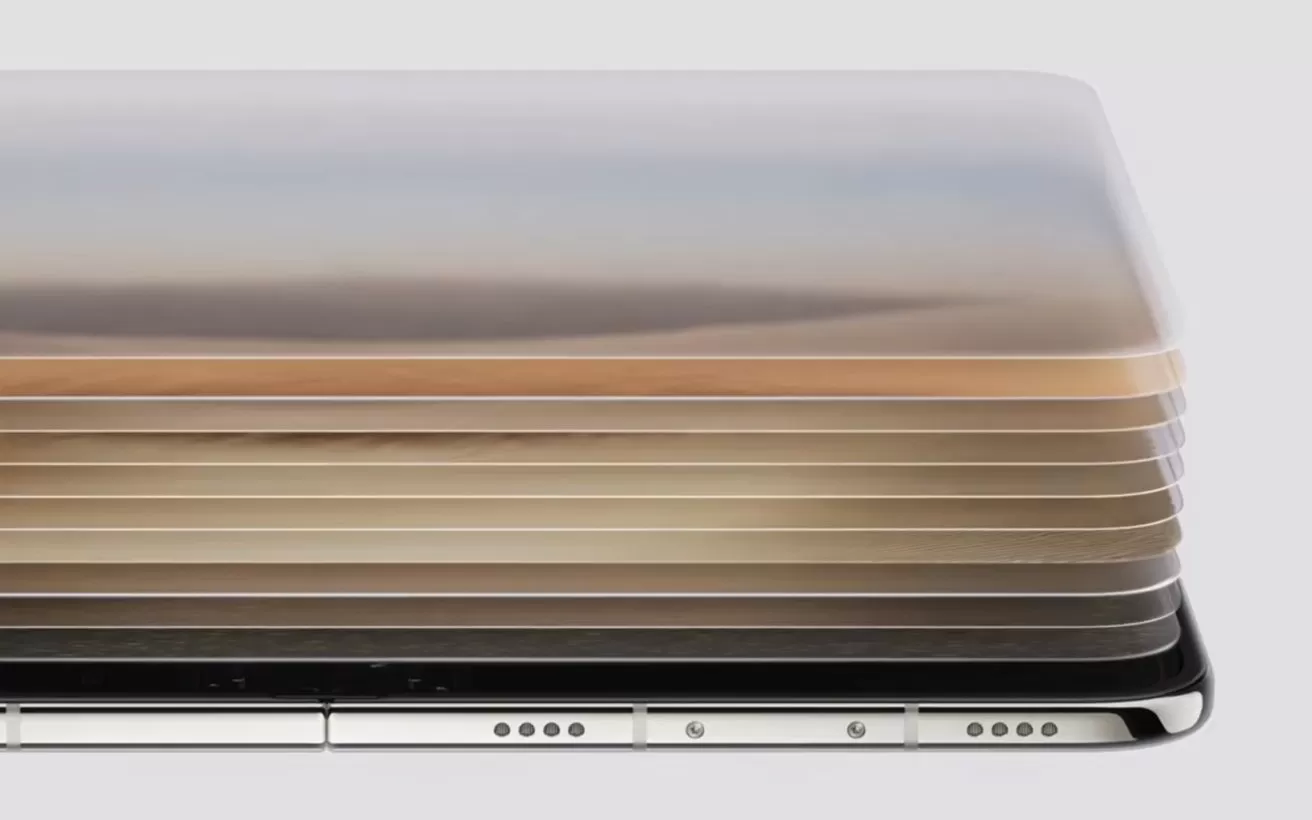
To that end, folding smartphone glass is not one sheet. Ultra-thin glass, which is both a product name and a descriptor, is sandwiched in layers. Each layer is thinner than a human hair.
Each layer has with a coat of sliding adhesive. When the device is open and closed, this allows the layers to remain intact and slide very slightly across its neighbor. A thicker, single piece of glass would crack and shatter, versus the bend and slide
The hinge makes sure every fold is about the same, and optimized for minimal and even stretching of the glass.
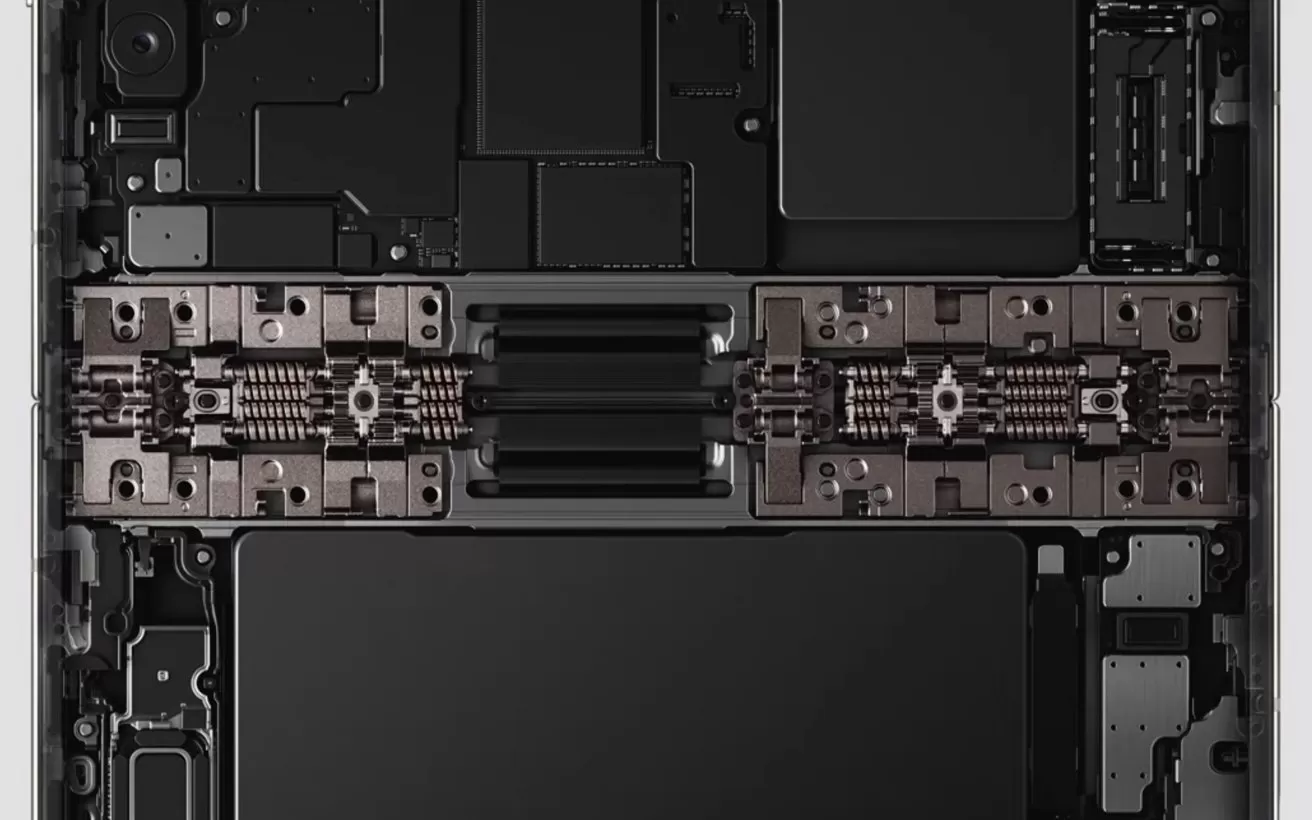
This hinge means everything to the iPhone Duo screen
Extremely thin glass isn't new. Apple's glass partner Corning made Willow Glass in 2012, and has been selling it on rolls ever since.
At the time, it was used for static curved screens, long before the first folding smartphone, and basically at the dawn of the OLED era. The two combined has led to where we are now.
And, it will crease. Every folding screen will, even Apple's.
Fatigue failure and that crease
For years, there has been discussion of that crease in smartphones. It was very apparent on early smartphones with plastic screens because of the material properties of plastic.
Arguably, most failures will be from user drops and other impacts. That's not what we're talking about here, but a drop will aggravate a crease formation.
Progressive fatigue on that hinge point is the main factor behind obvious crease development.
Crush a can in the center, and bend it until it tears. That is a practical, accelerated demonstration of the same way that a crease in a smartphone develops over time.
Apple is not immune to remorseless physics. Engineering can mitigate physics somewhat, though. The hinge is a key factor.
I'm reasonably confident that Apple has engineered a hinge that will retain its tightness and regularity. The uniform and precise fold, each and every time, will limit the variables that need to be controlled to minimize fatigue damage, because the folds are uniform and the stress points are known.
Every material has a minimum bend radius where the material will fail, or take damage. I spoke about this briefly above, but the hinge keeps the glass on the correct side of that line with an arc, not strictly a bend.
But, still, over time, micro-cracks will emerge along the hinge point. And over time, the screen will start to delaminate just a bit.
All of this damage is accumulative. Fortunately, most screens, likely including Apple's, are rated to survive about 250,000 folds over a product's lifetime.
Some napkin math suggests that's more than 125 shut-to-open and back again cycles per day over five years.
Along the way, though, that accumulating damage will be visually and touch-evident at the point of maximum stress. That point is the center of the hinge.
That point is the crease. A crease, even on Apple's $2000 folding iPhone, is inevitable. It is a matter of time, and use.
Apple and engineering
Every single engineering problem is a compromise between physics, the material that can be used, the engineering you can bring to bear, and the cost it extracts to make the material. It's been long said that Apple over-engineers a problem.
I can't think of a problem that needs an "over-engineered" solution more than minimizing accumulated fatigue in a hinged material.
Apple has had seven years to look at competitors and see how their engineering has failed, and how it's been engineered around. That's a lot of flaming data to use, and make sure that your product doesn't crash and burn like that.
Apple has done well here, but how well it has done is up to time and contact with consumers. There are already concerns about the folding, and there are going to be the idiots in Apple stores who like to pound on demo hardware, which will accelerate those cycles.
Expect to see people opening and closing the iPhone Duo dozens of times in minutes, grinning like a fool when they do it and recording it on their own iPhones for social media cred. This isn't FineWoven where the problems were obvious, so don't rely on those videos for any measure of success or failure.
We're also sure that Apple will capture every single one of those units that gets pounded on at retail and test it to the point of total destruction, like they do.
Phones will be destroyed for YouTube clicks, and the folks with infant failures that do happen, will complain disproportionately loud on social media.
Enjoy your tech. Being concerned about the crease at this juncture is a waste of your time, like min-maxing your battery with operational habits that may or may not help is now.
While the crease is inevitable, there is no indication today that it is a show-stopper. The phones are designed to be used, they are designed to be open and shut, they are designed to get that Uber, to watch that video, to surf that site.
We still have hooks inside Apple Stores' service departments. Let us watch the numbers, let us figure out if it's a giant problem like the stage lights on the 13-inch MacBook Pro a few years ago, or the butterfly keyboard was. Let us figure out if it's a problem that deserves some non-hysterical watching and discussion like the orange iPhone turning pink for some folks with an coating misapplication at the factory in some early production units.
And, Apple replaced or fixed all of those actual issues.
Until then, ignore the folks that test to failure, and use your iPhone Duo. Report issues to Apple, and we'll let you know if there's a problem over time.